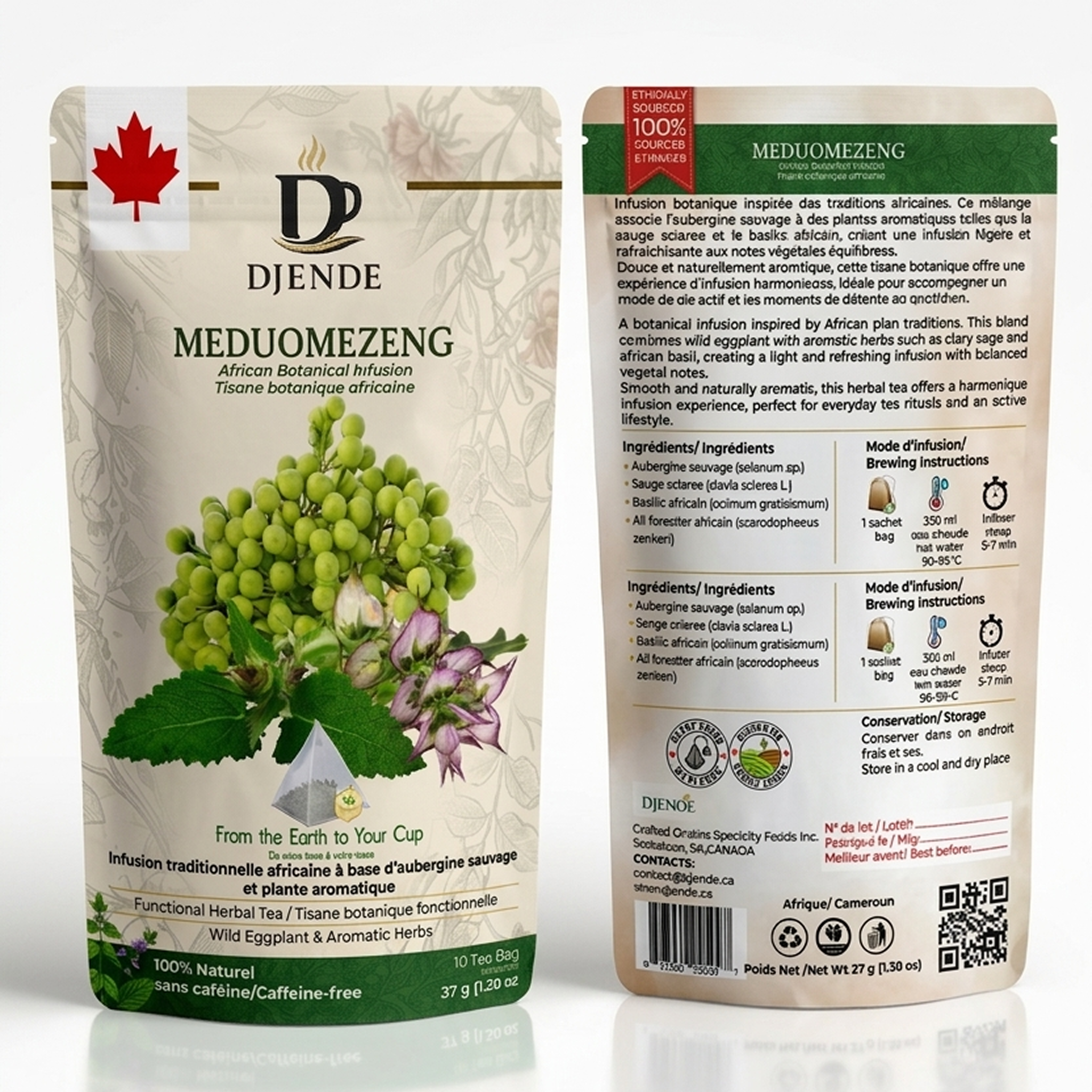
These four plants do not appear in mainstream Western wellness. They come from the forests of Cameroon, where they have been used in local tradition for generations. Meduomezeng is DJENDE's most distinctive blend — and its most rooted in African botanical heritage.
⚠️ Note: This article is based on traditional uses documented in Central African herbal practice. It does not constitute medical advice. Some ingredients may be unfamiliar in Western pharmacology — consult a healthcare professional before use if you have a medical condition.
The 4 Botanicals — Decoded
Wild Aubergine
Solanum torvum
Central African forests
Anti-inflammatoryTraditional tonicAntioxidant
This is not the aubergine of your kitchen. Solanum torvum — known as wild aubergine or turkey berry — grows in tropical forests across Africa and Asia. In Cameroonian tradition, it is used as a general tonic and anti-inflammatory. It contains steroidal saponins and alkaloids that have attracted significant pharmacological interest.
Clary Sage
Salvia sclarea
Mediterranean & Central Africa
Hormonal balanceCalmingAnti-inflammatory
Clary sage is well-documented in European herbal tradition for its effects on hormonal balance and stress response. In Central Africa, it is used as a calming, grounding herb. Its main active compound, sclareol, has been studied for its anti-inflammatory and antimicrobial properties.
African Basil
Ocimum gratissimum
West & Central Africa
AntimicrobialAdaptogenicAromatic
Often called 'fever plant' in West Africa, African basil is a more potent, resinous relative of culinary basil. Used across Cameroon, Nigeria, and Ghana in traditional medicine for its antimicrobial and adaptogenic properties. Its essential oil is rich in eugenol — the same compound found in clove — giving it a warm, spicy aroma distinct from European basil.
African Forest Garlic
Wild allium sp. (Haut-Nyong)
Central African forest understory
Immune supportCirculationAntimicrobial
Known locally in the Haut-Nyong region, African forest garlic is a wild allium used in traditional Cameroonian medicine for immune support and circulation. Like all allium species, it contains allicin compounds with well-documented antimicrobial activity. Its flavour is gentler and more herbal than common garlic.
🌍African botanical heritage
Four plants from Cameroonian forest tradition — not found in mainstream blends.
🛡️Tonic & immune
Wild aubergine and forest garlic — traditional tonic and immune-supporting plants.
🧘Balancing & calming
Clary sage and African basil — adaptogenic, grounding, aromatic.
✦ Why Meduomezeng Is Unique in DJENDE's Range
Every other DJENDE blend uses ingredients that are familiar to Western consumers — chamomile, ginger, bergamot. Meduomezeng is different. These four plants come directly from the forests around Djende I, the village in the Haut-Nyong region of Cameroon where DJENDE's story begins. They represent a botanical tradition that does not appear in mainstream wellness — and that is precisely their value. This blend exists because these plants deserve to be known beyond the forest.
How to Brew Meduomezeng
🌡️Temperature95–100°C
Near or full boil — roots and bark need maximum heat.
⏱️Time6–8 min
Longer than standard — allow the botanicals to fully open.
🕐When?Any time
Caffeine-free. Morning tonic or evening grounding ritual.
⚠️ Meduomezeng contains botanicals that may be unfamiliar in Western pharmacology. Wild aubergine contains alkaloids — not recommended in large quantities during pregnancy. Consult a healthcare professional before regular use if you have a medical condition.



Leave a comment
This site is protected by hCaptcha and the hCaptcha Privacy Policy and Terms of Service apply.