

Our Story
from heritage to integrity, from origin to cup.
The Coffee Plants Behind Grandfather's House
Some memories never fade. For me, it is the image of the coffee and cocoa plants behind my grandfather's house in Djende I. We were so young — but Alphonse was already teaching us. He showed us how to clean the plants, how to pick the coffee cherries into the basket, how to avoid wasting a single one. Every gesture had meaning. Every bean counted.
Better still: when harvest time came, he had built a vast dedicated space — a drying and sorting area he had designed himself. That was where we all loved to gather. We sorted cherries while he told us stories from Africa. The forest around us. The sun on the red beans. His voice.
Alphonse was not just a farmer. He was the builder of Djende I. He had chosen to move closer to his fields, moving away from the main road — to develop large plantations and work the land with greater proximity and care. He was one of the greatest farmers in the commune of Doumaintang. He farmed to feed his family, yes. But above all so that each of his children could go to school.
"He taught us that the land does not lie. What you give it with patience, it gives back with interest."
— In memory of Miambe Alphonse, Djende I
Elisette and the School of Djende
The public school of Djende did not always exist. The nearest school was around 10 km from the village — an impossible distance for primary school children. Many went to live with aunts settled in other villages, or with family friends, just to access a classroom. Others simply gave up. Under-schooling was deep and silent.
Elisette decided this could not continue. She contributed to building the public school of Djende — donations in kind, administrative efforts, iron determination. She wanted children to love school, to no longer have to choose between their family and their future.
She did not stop there. Every year, she paid the school fees of more than 200 children. She donated school materials — chalk, slates, books, uniforms. She helped parents pay the volunteer teachers who taught classes while the government failed to assign permanent staff. She considered herself lucky to have had access to education in an era when schooling girls was seen as pointless — since their destiny was marriage. She refused to let this injustice continue.
Elisette believed girls had as much right to school as boys. That parents should no longer have to choose which child they could afford to educate that year. That the price of coffee and cocoa should not decide a child's future.
"She considered herself lucky to have had access to education. And she had decided she would share that luck."
— In memory of Elisette, eldest and builder
May 2022: When Grief Becomes Responsibility
In May 2022, Elisette leaves us. Long after grandfather Alphonse's death, this is new grief. But for us, it is sorrow. For the hundreds of children of Djende, it is a catastrophe.
Because it was May — in the middle of the school year — the impact of her passing is immediate. Many children can no longer afford to attend school. Volunteer teachers, whose salaries had not been paid for months, leave. The future of hundreds of children darkens in a matter of weeks.
As Elisette's eldest, I receive the grievances and pleas of Djende's farmers. In 2022, then 2023, my brothers and I contribute from our own pockets to continue her work. But I quickly realise that, having immigrated to Canada in 2023, I cannot sustain this model. Personal charity has its limits. And the children of Djende cannot depend on my pocket.
Something larger is needed. Something that works even after I am gone. Something that will not one day become a burden for my own children.
The Birth of DJENDE: A System, Not a Handout
This is how the DJENDE project was born. Not a charity. Not occasional aid. But an economic model built to make Djende's farmers autonomous — so that their work is fairly paid, so that their coffee and cocoa reach markets that recognise them.
Traceable sourcing — you know exactly where what you buy comes from. We work directly with GICs (Common Initiative Groups) and farming families from Djende and elsewhere in Africa — without exploitative middlemen, at fair prices. A portion of my profits from every sale goes to the education of partner farmers' children. And the Miambe-Elisette Foundation is being structured to frame these actions in a lasting, systemic and transmissible way — for Djende's farmers and their children.
I am one of the grandchildren with whom Alphonse spent the most time. I am Elisette's eldest — I knew most of her projects, I knew how dear Djende's community was to her, how much she cared that girls had as much right to education as boys. I was already carrying this legacy before I knew I would formalise it.
As a woman, I feel this issue even more personally. If my mother had not been educated, I would probably have been one more victim of this system — one more girl whose future would have been decided before she had the chance to decide for herself. This reality is not abstract to me. It is personal. And that is precisely why DJENDE cannot be merely a commercial project.
"DJENDE was born from taste and from responsibility. And from a refusal to let the future of these children depend on a coffee price set by a market they cannot control."
— Founder of DJENDE
Made in Canada — The Quality Promise
From origin to your cup, every step matters. That is why our ingredients are processed, blended, roasted and packaged in Canada — to Canadian standards, with the same discipline Alphonse applied to his harvests. African heritage. Canadian rigour. For us, this step is not separate from the origin — it is part of it. It allows us to honour the character of each ingredient while delivering the standard of excellence you deserve.
What You Carry in Your Cup
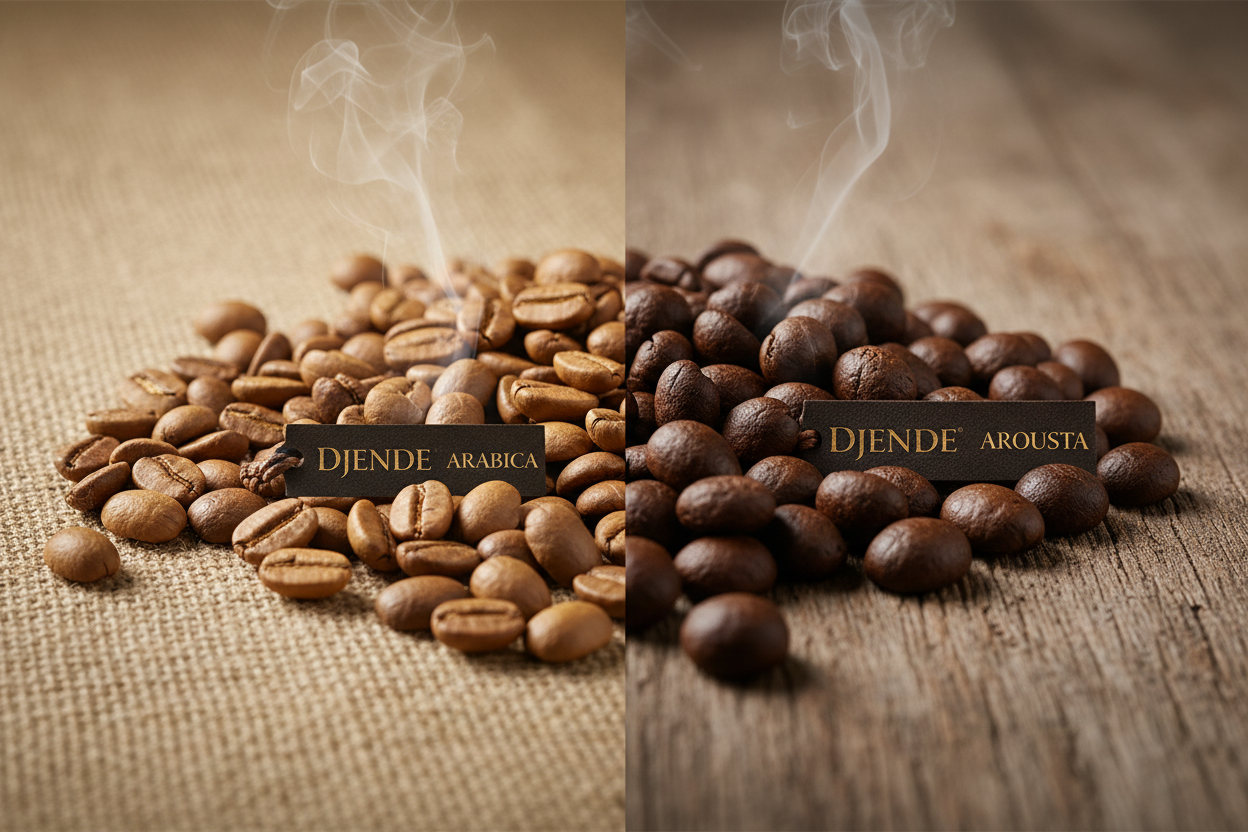
When you choose DJENDE, you are not just choosing a quality coffee or herbal tea. You are choosing to be part of something larger.
|
What DJENDE carries |
What this means concretely |
|
Alphonse's legacy |
Direct sourcing at Djende I — the same lands he farmed, honoured with care |
|
Elisette's vision |
A portion of my profits from every sale contributes to the education of partner farmers' children |
|
Traceability |
You know exactly which land your coffee comes from — Doumaintang commune, Haut-Nyong, Eastern Cameroon |
|
Fair payment |
We work with GIC and farming families from Djende and beyond — paid what their work is truly worth |
|
Canada |
Processing, blending and packaging in Canada — freshness, consistency, quality standard |
|
Sustainability |
Miambe-Elisette Foundation being structured — for Djende's farmers and their children |
DJENDE — From the land to your cup.
Alphonse taught us that true quality is cultivated with patience. Elisette reminded us that this quality must also create dignity, opportunity and continuity for those who produce it. Together, they are the soul of DJENDE. And every cup you prepare carries a little of their story.
✨ Taste the legacy of Djende in your cup
Coffee, teas and herbal infusions directly sourced — carefully packaged in Canada.
DJENDE • From Our Lands to Your Cup • djende.ca • @djende.ca

Leave a comment
This site is protected by hCaptcha and the hCaptcha Privacy Policy and Terms of Service apply.